
By
The one big thing that people have in common is that we all will die, and we likely will experience the death of someone we love, too.
And yet despite this shared future, death can be hard to talk about, because it’s not an experience that anyone can report back from to say how it went. When you or a loved one starts approaching death, the existential stakes can go from theoretical to personal, sometimes feeling emotionally, physically and spiritually fraught.
That’s why it can help to hear the insights of people who see death all the time, because understanding it now can help us better process grief about others and feel more at ease when thinking about our own mortality.
The physical process of dying doesn’t look like it does in the movies.
This was a repeated theme among the experts I spoke with. Pop culture may have you thinking that death happens quietly and quickly, with eyes closing and arms crossed, but dying from natural causes often looks different in real life.
“My own dad said to the nurse, ‘I’m about ready to hang it up,’ and then he died minutes later. But that type of death is very uncommon,” said Penny Smith, a hospice quality manager and registered nurse in Washington state.
In her decadeslong career, Smith said she’s only come across a few instances in which people died quickly.
“It’s usually more of a process where they go into that unresponsive state, and there’s all kinds of things going on with their body. Their color’s changing, their breathing is changing and then they finally slip away,” she said.
“As a hospice nurse, I have been with so many families where they were really disturbed by what they were seeing, or scared. And I would say: ‘That’s normal. We see that all the time.’ The relief is palpable,’” Smith said.
Among all the physical processes of dying, Smith said the biggest misunderstanding she sees is when family members worry that their loved ones are dying of starvation because they’ve stopped wanting to eat.
“These are people who are already dying. They don’t need the food,” Smith said. “And when the family starts to try to force them or coerce them into eating just by, ‘Come on, just have a bite just to eat something,’ it just sets up so much stress between the family and the person.”
Similarly, families often worry that the use of morphine and other opiates will hasten the death of loved ones, according to Frances Eichholz-Heller, a senior social worker for the palliative care consult service at NewYork-Presbyterian/Columbia University Irving Medical Center.
“Some people will say to me, ‘Well, we had an uncle who was in the hospital dying, and then as soon as they put the morphine on, he died really quickly,’” Eichholz-Heller said. “I have to explain to them: ‘Well, he probably died really quickly because he was dying. He wasn’t dying because of the morphine, but they put him on the morphine to help.’”
Families can live with a lot of regret over what they should have done.
If you are seeking to support a loved one who is dying, be mindful of how your own fear and discomfort could impact what a dying person shares with you, said Dr. Aditi Sethi, a North Carolina-based hospice physician and end-of-life doula.
According to Sethi, some dying people try to talk about their experience with loved ones but the families dismiss it because of their own discomfort, using language like “You’re not dying, don’t worry about it.”
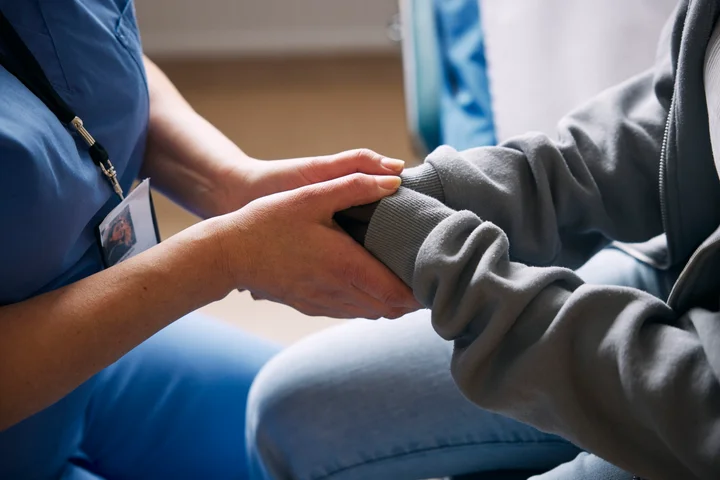
“So many times, loved ones have the most regret,” Sethi said. “They’re so terrified of losing their loved one that they can’t be fully present to their loved one at the time when they need them the most, really — to hold their hand and to really honor what they’re going through, and have a space to share what they’re experiencing in this epic journey they’re about to embark on.”
But if you had a strained relationship with the person before they were dying, don’t feel like you have to force a connection that is not authentic, either. “Your relationship with the dying person is personal, and if you didn’t have a good relationship, you are not obligated to go and be with that person,” Smith said.
It’s also important to provide space for people to be themselves when they are grieving, said Ladybird Morgan, a California-based registered nurse, palliative care consultant for the company Mettle Health, and co-founder of the Humane Prison Hospice Project nonprofit.
“I really ultimately believe that what happens is what needs to happen. And I see a lot of suffering for families that get left behind when they feel like they should have done something different,” Morgan said. “You grieve the way you’re going to grieve. You let go the way you’re going to let go. I tend to want to be careful about saying, ‘You should do X, Y and Z.’”
Not everyone wants silence or a somber mood when they are dying.
Health care providers and family members can make assumptions about what a dying person would find comfortable, without considering what that person truly enjoys. Some people may desire silence, but others may welcome raucous celebrations.
Smith recalled worrying about a football game party happening in the room of a dying woman until one of the patient’s adult sons reassured Smith that this was her passion.
″[The son] said: ‘Oh, my gosh, she was the queen of football parties every Sunday [with] everybody in the neighborhood. Yes, she loves this,’” Smith said. “I was new in my hospice career and making assumptions about what I thought a dying person would want. I thought they would want a quiet, dark room, and that’s not necessarily the truth.”
Not enough people plan or talk about how they want to die.
Most Americans say that given the choice, they would prefer to die at home, but about 1 in 5 deaths in the U.S. occur after admission to an intensive care unit. In the book “Extreme Measures: Finding a Better Path to the End of Life,” Dr. Jessica Zitter details what she calls the “end-of-life conveyor belt” — a type of care in which dying ICU patients receive painful treatments to be kept at alive at all costs.
“Unfortunately, by the time someone is on the conveyor belt, it’s often too late to talk to them about what they want. And then everybody is trying to play catch-up. And it’s hard to get it right when the chips are down and there’s so much emotion,” said Zitter, who specializes in palliative medicine and critical care.
“So my recommendation is to talk about these issues early on in life, maybe starting when you become an adult. Start to think about your mortality, and visualize how you would want things to go for you when you get into that stage of life, the end stage. Communicate honestly.”
Filling out forms for so-called advance care planning goes a long way. But “it’s as important that you, number one, identify a person you trust — or two or three [people] — that can honor your wishes,” Sethi said, “and have the conversations ahead of time, before you’re in the state where you can’t communicate your needs and wishes.”
Some hospice workers recommended Five Wishes, an advance care planning program, as one way to get clarity on how you want things to go.
Morgan recommended playing a card game called GoWish with a friend, a partner or someone else you hope will follow your end-of-life wishes. “[The cards] have different statements on them about possibilities of what you might want or not want,” she said. “And you make stacks of the ones that you like, the ones that you know you don’t care about, and the ones that you’re not sure about.”
Someone playing the game may find it difficult to choose which cards represent their values, which is why Morgan suggests having two people play together, so that it can be a conversation starter.
Keep in mind that there is no one right way to die, and preferences may differ.
“There are people who feel that every moment of life is precious and that they value the length of life over the quality of life,” Eichholz-Heller said. “So they are willing to endure a certain amount of suffering to be able to be kept alive. Then there are other people who value quality of life over length of life. And they would rather focus on comfort, even if it means that they won’t live as long.”
There are still a lot of negative associations with hospice care, even though it can be helpful.
There’s a difference between palliative care and hospice. Palliative care workers help to make patients comfortable at any stage of their life if they’re suffering; hospice is a medical service specifically for people with a short-term life expectancy. While anyone living with a serious illness can seek palliative care, Medicare will help cover hospice care costs for people in the U.S. if their health care provider certifies that they are terminally ill and have six months or less to live.
Some people wrongfully assume that going into hospice automatically shortens the life of a patient. Smith said she has been called a murderer for working in hospice care, adding that the worst myth about hospice workers is that they kill their patients.
“People think that when you go on hospice, it’s a death sentence and that death is imminent,” Smith said. She cited former President Jimmy Carter, who was in hospice care for more than a year and a half before he died, as one prominent example of how that is not always the case.
In fact, research shows that seeking palliative care at an early point can improve quality of life. Published in 2010, one study on advanced lung cancer patients found that offering early palliative care on an outpatient or ambulatory basis led to fewer clinically significant depressive symptoms and a longer median survival.
“When patients are suffering, they use so much of their energy just to fight the suffering that if we can make them comfortable, they sort of stabilize,” Eichholz-Heller said. “And a lot of times, it really helps them to live longer.”
Hospices can differ in their approach to care and the additional services they offer. There are resources that can help you figure out the right questions to ask to select the best hospice for you or a loved one.
We can’t control death.
There can also be a misunderstanding about the medical community’s ability to defeat death — even from health care workers themselves.
“The biggest misunderstanding that I see [among] patients, families and even health professionals around the issue of death is that we think we can control it,” said Dr. Solomon Liao, a UCI Health physician in California who specializes in palliative medicine and geriatric pain management.
“We believe that with all of our machines, technology and medications, we can determine when or even if that happens. Instead of accepting death as a natural endpoint of this life, we get depressed and even angry when it happens. We avoid planning for it or even talking about death, and then are shocked when it happens.”
The reality is that we can’t control death ― and we’ll all experience it at some point. “The people that I notice that have the least amount of distress are the ones — not so much that they’ve controlled every element, but that they have lived really fully, and that they can say to themselves, ‘I was here,’” Morgan said. “And people around them can honor that and acknowledge that like, ‘Yeah, we saw you, we felt you.’ … And that was so important for them, allowed a deep relaxing into what was coming next.”
At the same time, it’s OK not to be ready.
“It’s OK to miss life,” Morgan said. She recalled talking to a client about how he knew everyone else was going to be all right after he died, and how that was heartbreaking for him.
In our conversations, hospice and palliative care providers suggested that it’s helpful to keep an open mind about death — leaving space for it to be “both and,” as Morgan told me.
Death can be devastatingly sad, but it doesn’t only have to be a somber occasion. Dying may be painful due to a terminal illness, but it’s not inherently so, Sethi said.
“It can be positive and hard,” Morgan said. “It can be, ‘It was exactly what needed to happen, and they had a beautiful death’ and ‘Wow, was that hard to see them go because I would’ve loved to have had them around for 10 more years.’”
###